Storefront Door Locks
There are only a couple of inches of metal to work with, and that single dimension decides nearly everything about these doors.
Call (408) 418-0044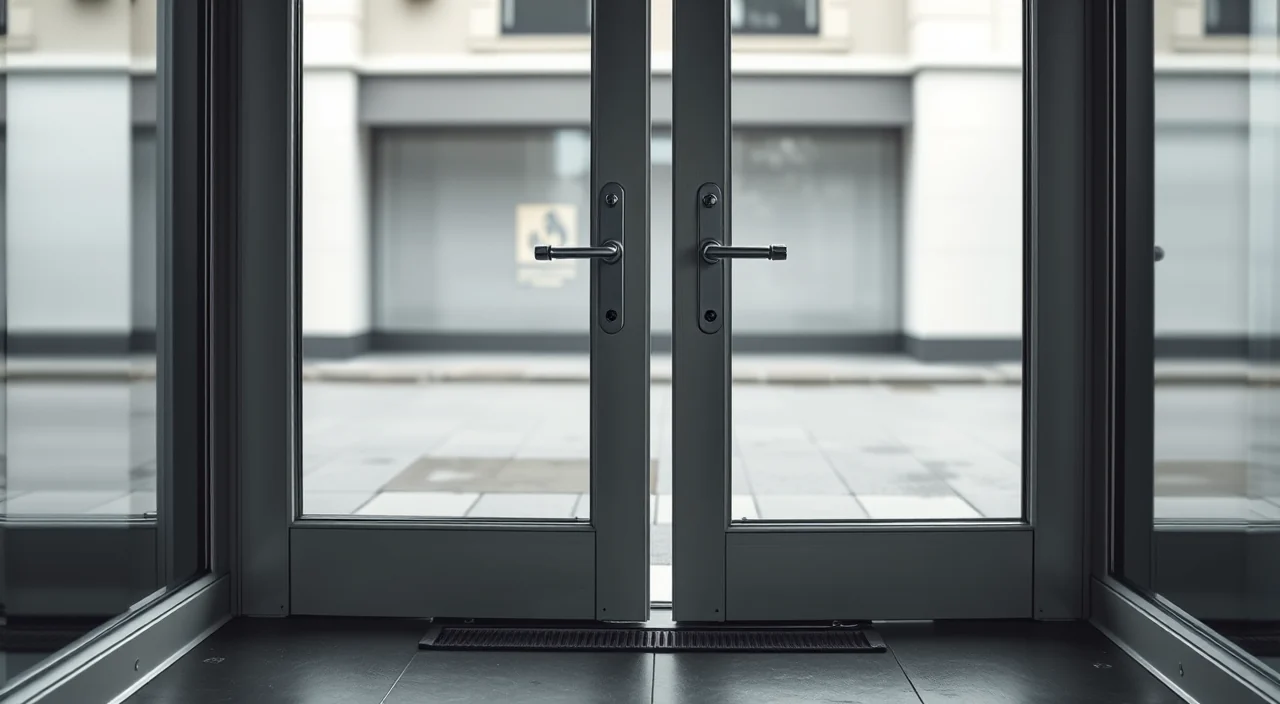
A storefront door is an aluminium frame wrapped around a sheet of glass, and the vertical rails at each edge — the stiles — are often barely wider than a lock case. That dimension rules out most hardware sold for solid doors and explains why storefront locks are their own family: narrow deadlatches, hookbolts that swing sideways into the jamb, and mortise cylinders held by a small set screw rather than deep threads.
These doors also move in ways solid doors do not. They hang on pivots rather than hinges, they carry a lot of glass weight offset from that pivot, and the aluminium grows measurably between a cold morning and a hot afternoon. Locks on storefronts therefore fail through alignment far more often than through wear, and a door that locked all winter and stopped in July has usually broken nothing at all.
What is specific to these doors
- Stile width. Narrow, medium and wide stile doors take different lock bodies, and the width is measured before anything is ordered rather than guessed from a photograph.
- Hookbolt or deadlatch. A hookbolt swings out and grabs, which suits a pair of doors meeting in the middle. A deadlatch suits a single door closing into a frame.
- The pivots and the bottom rail. A worn bottom pivot lets the door sag, and the bolt then misses the keeper by exactly the amount the door has dropped.
- The keeper position in the jamb or the threshold, which is slotted for adjustment precisely because these doors are expected to move.
- The cylinder — normally a mortise cylinder with a cam, retained by a set screw in the door edge, and changeable without disturbing the lock body at all.
Useful detail when you call
- Whether it is a single door or a pair, and whether both leaves lock.
- Whether it fails to lock, fails to unlock, or fails to latch when it swings shut.
- Whether the failure comes and goes with the time of day or the weather.
- Whether the door drags on the threshold or the top rail rubs the frame.
- Whether an exit device is fitted on the inside, which changes what may be done to the door.
If the glass door is the way out of an occupied space and the inside hardware is a push bar, the egress rules govern what can be fitted alongside it. see panic bar repair and installation.
Common questions
Our storefront door needs a hard pull to lock. Why?
Because the bolt is not lining up with the keeper and you are pulling the door out of position to force the fit. That is nearly always a sagging pivot or a keeper needing to move a few millimetres, and it is worth catching early — every hard pull loads the lock and the door corner until something eventually gives.
Can a deadbolt be added to a glass storefront door?
Only within what the door allows. The stile has to be wide enough to take the case, and if the space is occupied while the door is locked, the inside must still release in one motion without a key. That combination usually points to a lock with an inside lever or paddle rather than a plain thumbturn deadbolt.
The key turns but the door still will not open.
Usually the bolt is withdrawing correctly and the door itself is bound in the frame, or the bottom rail has settled onto the threshold. Look at where the door is touching the frame rather than at the lock, particularly if it takes a shoulder to move it.
Can the cylinder be changed without replacing the whole lock?
On most storefront hardware, yes, and it is a small job. A set screw in the door edge releases the mortise cylinder and a replacement of the correct length and cam goes in. Length matters in both directions: one projecting too far is exposed to attack, and one too short will not reach the mechanism.
Related locksmith services
Describe the lock or key problem
A short description of what happened gets the right tools on the vehicle.
Call (408) 418-0044